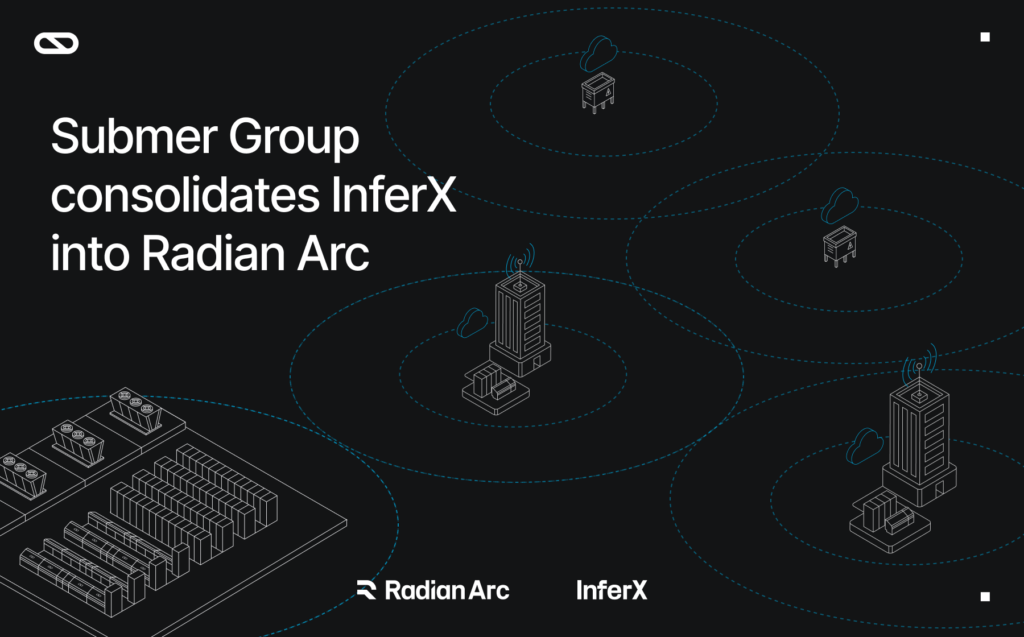
InferX™ and RadianX™ become the two product families of Radian Arc, which provides GPU infrastructure for AI inference and cloud gaming across core data centers, and telecom networks. The new website is live at www.radianarc.com.
BARCELONA, Spain – Sept. 17, 2026. Submer Group, the market-leading end-to-end AI infrastructure company, has consolidated its InferX GPU-as-a-Service brand into Radian Arc. The company now goes to market under one name, with InferX and RadianX as its two product families.
Submer Group acquired Radian Arc in 2026, with the acquisition bringing together two complementary businesses: the Radian Arc GPU cloud platform for telecom operators, and InferX, Submer’s NVIDIA Cloud Partner GPU-as-a-Service business. The two have sold separately until this point, but the consolidation now represents the complete AI cloud layer of Submer Group’s end-to-end AI infrastructure stack. Radian Arc now delivers comprehensive GPU-as-a-Service and AI-as-a-Service across core and edge locations. This builds on Submer Group’s liquid cooled thermal architectures, modular data center solutions reducing time-to-token through industrialized AI infrastructure delivered at scale, and on Rubix, the group’s data center development and operations company, with 8 GW+ of land and power secured.
What Changes
- Radian Arc becomes the master brand and the point of contact for customers, partners, and investors.
- InferX continues as the product family for sovereign GPU and AI services, covering InferX GPU-as-a-Service and InferX Enterprise AI Services. NVIDIA Cloud Partner status, customer agreements, and capacity commitments are unaffected.
- RadianX becomes the product family for cloud gaming, partnering with network operators and game publishers.
Radian Arc deploys GPU infrastructure built for high-performance applications such as AI inference, rather than general purpose cloud. It deploys capacity in core data centers, in partner facilities and inside telecom operator networks, and routes workloads between those locations based on latency, data residency rules, cost per token and which model is best suited to the specific application and workload. The company’s focus is to maximize intelligence per Watt as a compute outcome, meaning more useful output from the GPUs and the power already installed.
The consolidation reflects a change in what AI infrastructure is being built for. Inference has moved from a minority of AI compute to the majority of it, accounting for roughly two thirds of all compute in 2026, up from half in 2025 and a third in 2023, according to Deloitte[1]. Inference workloads run constantly and fall under the data residency rules of whichever country they run in, which changes where capacity has to sit.
“Our objective is to be simple to do business with,” said David Cook, CEO, Radian Arc. “Under one brand a customer only needs to know Radian Arc. From there the conversation centers on what application you’re running, how much capacity it needs and which country it needs to run in. We can provide an outcome-optimized solution for most answers to these questions, and buyers do not expect that from a single supplier.”
Radian Arc has more than 90 telecom partners and thousands of GPUs in operation, with a presence across North America, Europe, the UK, India, the Middle East, and Asia-Pacific. Telecom operators run the platform inside their own networks, delivering cloud gaming and AI inference to customers who need low latency.
The new site sets out both product families, the routes to market and the sectors Radian Arc sells into, including government, smart cities, telecoms, healthcare, agriculture, and meteorology.